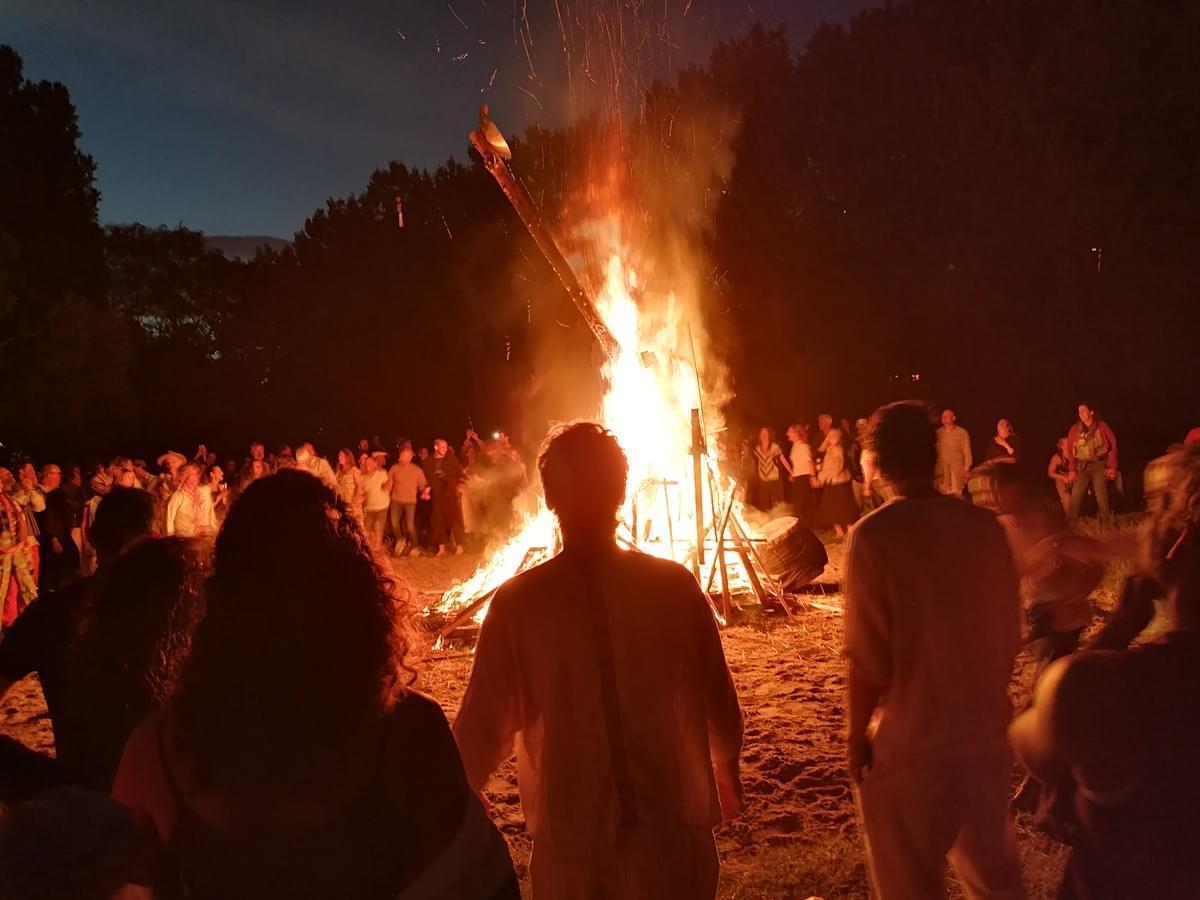
These logbooks outline our day-to-day and key milestones of our projects. We share our successes, our setbacks, and our lingering questions. Think of it as ongoing documentation - imperfect and ever-evolving. This particular edition takes you to Katapult, an unusual event which gathers every year a diversity of funders, entrepreneurs and systems thinkers to push the field of regenerative finance forward. This was our first Katapult, and sincerely, hoping this won't be the last. Enjoy the read! 😊
Igor at the keyboard.
Last week, I found myself in one of the most unexpected environments imaginable. Two antipodes of the system coexisted for a few days. One was hosting, the other organising. Both had gathered around a shared ambition: to fundamentally rethink the financial system - to transform it from a tool of domination serving the few into a tool of connection serving all the living.
Over two days, the Katapult festival brought together nearly 900 people. I don't have the exact breakdown, but from my conversations I'd estimate roughly half working in finance (investment funds, family offices, venture capitalists, foundations, etc.), the rest comprising institutional actors, entrepreneurs and project leaders, artists, and community representatives.
Somewhere at the crossroads of Burning Man, TED Conferences, and the facilitation world - open forums, talking circles, collective intelligence. A distant echo of the experiments Stewart Brand ran in California in the 1970s and 80s, when he sought to bring together hackers, artists, and systems thinkers around questions that defied disciplinary boundaries.
Here's a short account of those few days.
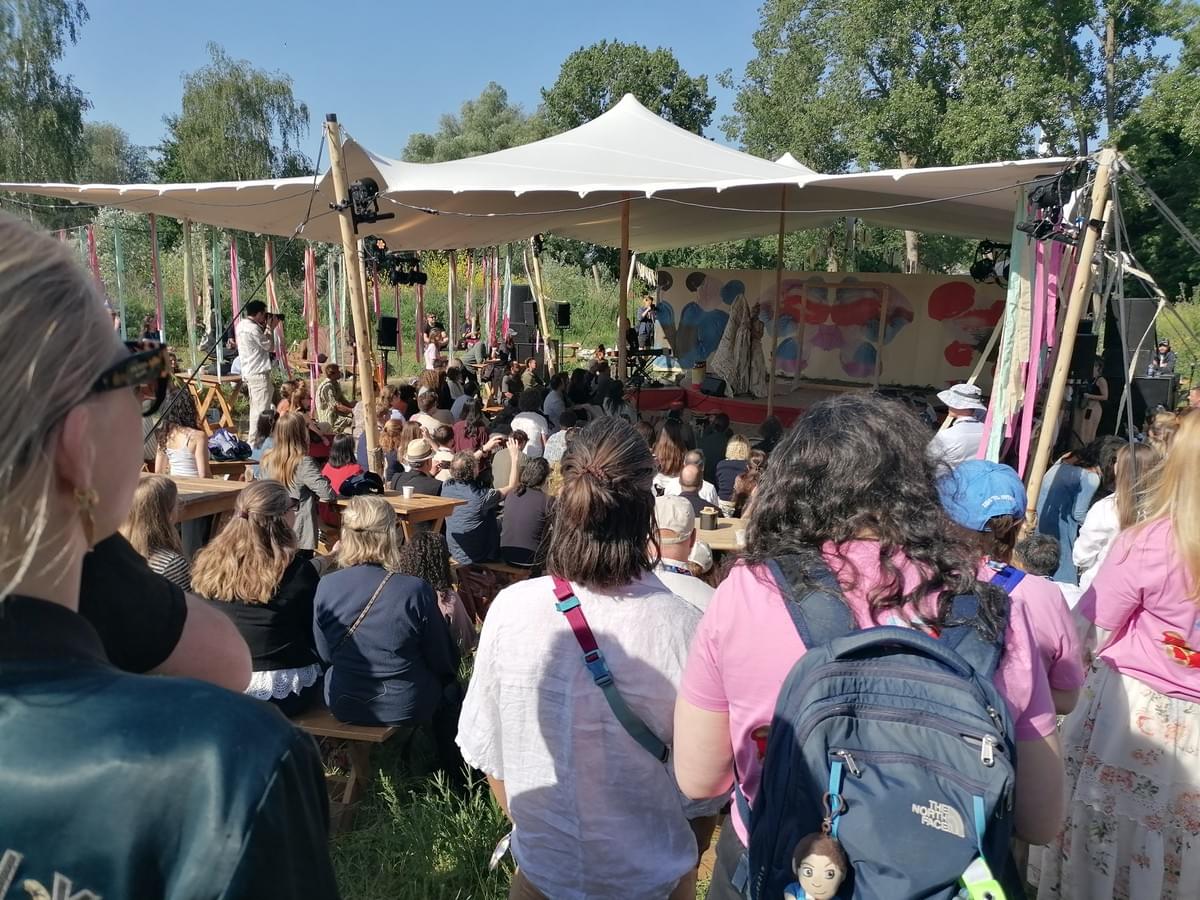
I arrive in Amsterdam on Wednesday evening. I join our partners from BWLC and the Wire Group at an opening dinner - aimed primarily at an investor audience. The dinner is held outdoors, in a stylish venue. Live music, a banquet, good food. But as is my habit in these intensely social environments, a strong sense of loneliness sets in. Aside from one or two people (wink, Courtney!), I struggle to connect - searching for a foothold, finding none. I drift to the edges. Until a kind soul introduces me to... Ferran! Late twenties, infectiously good-humoured, doing exactly what I do, in his home region of Catalonia. We click instantly. Saved for the evening. But two full days more of this - I brace myself for a long haul.
Thursday 8:00am — Arriving at Ruigoord.
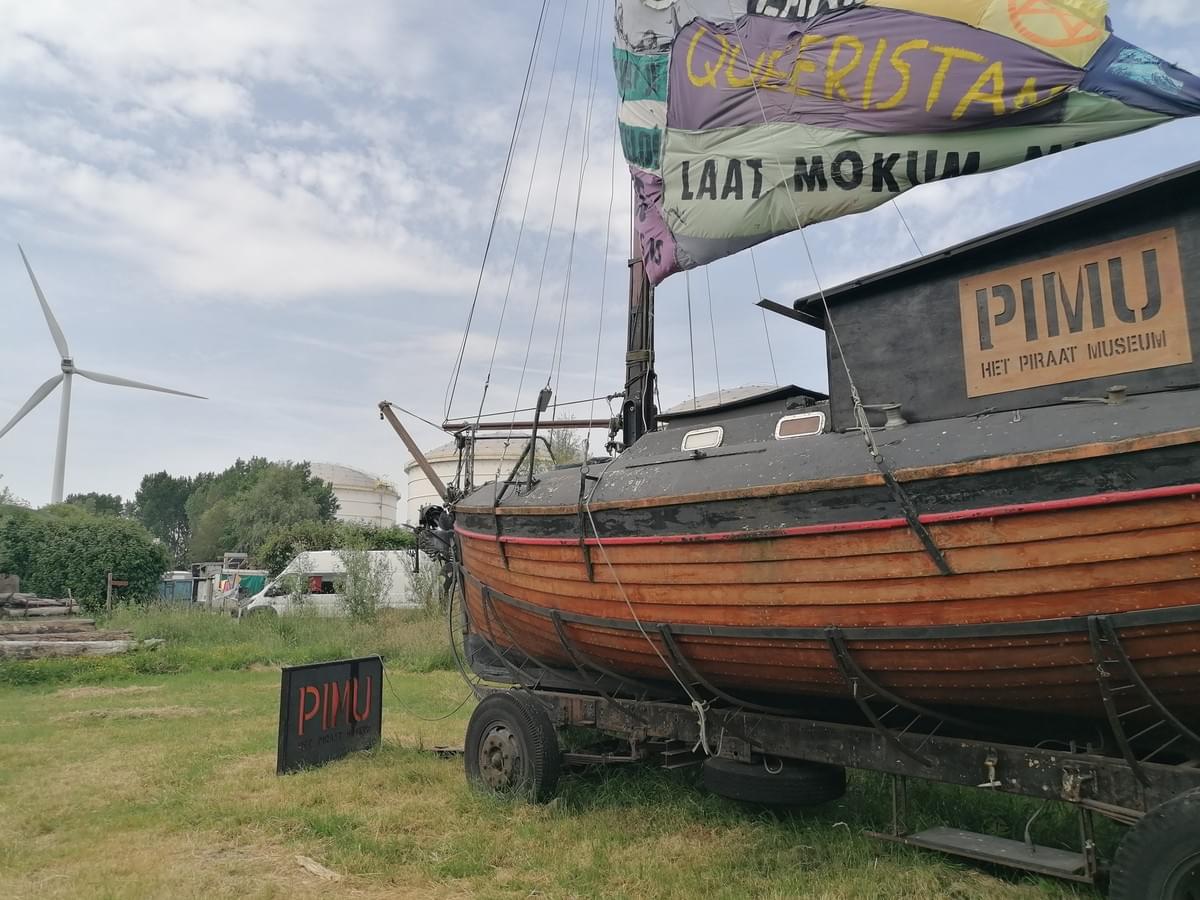
The community hosting the festival for the next two days. A former fishing and farming village, Ruigoord should have disappeared in the 1960s. The Amsterdam municipality had decided to raze it to the ground to build a petrochemical port. Residents expelled, houses emptied. In 1973, a handful of artists, idealists, and former activists from the Provo movement barricade the road on the very day the bulldozers were due to arrive. The oil crisis of the 1970s does the rest: the port project collapses, and Ruigoord becomes a cultural free zone. An enclave surrounded by giant oil tanks, container terminals, and industrial warehouses - as far as the eye can see. Enormous wind turbines too, whether you love them or not.
Artistic expression, political struggle, global supply chains, energy systems. The world in all its complexity, gathered on a few hectares. Could we have hoped for a better setting to host a festival aimed at reimagining finance in service of the living?
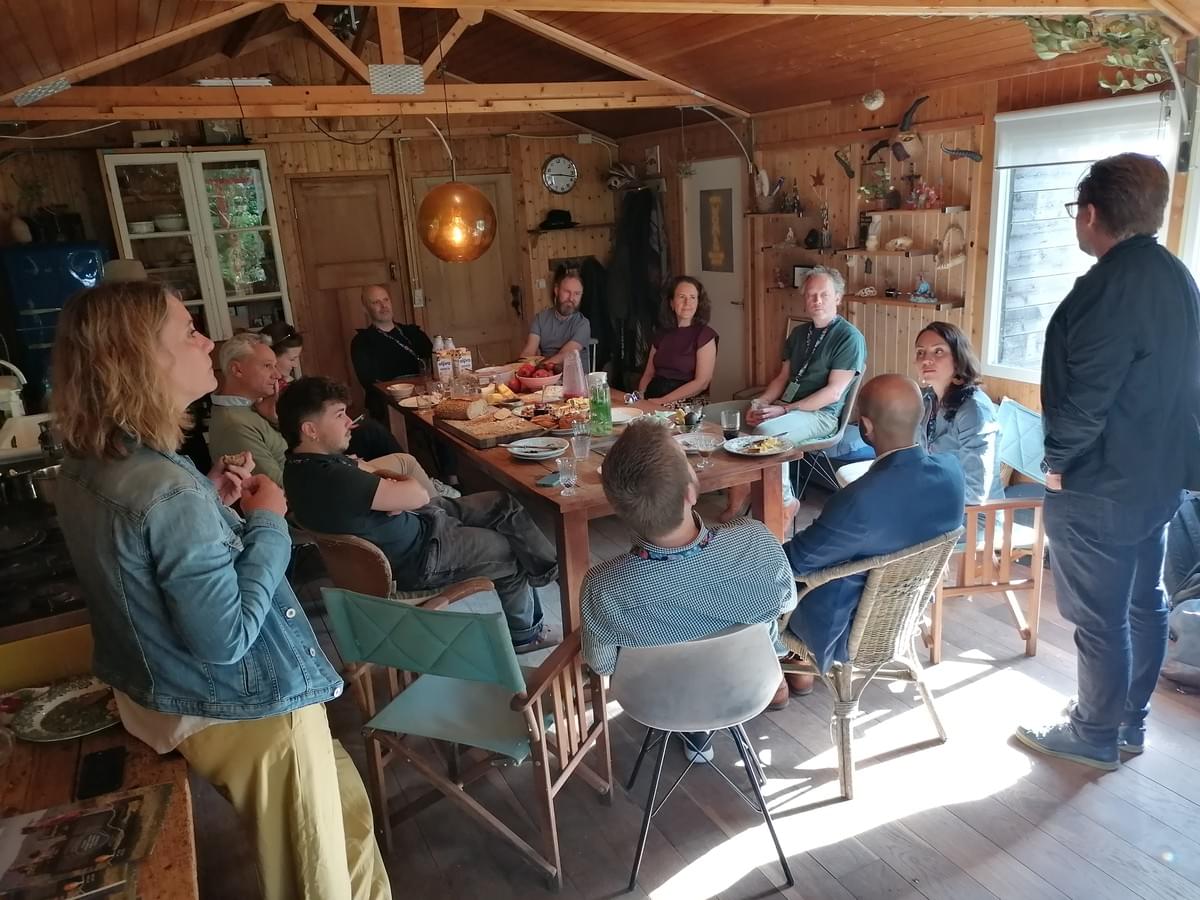
8:30am — Breakfast with the BWLC team and a few investors and institutional partners.
A dozen people. Getting to know each other. Good energy, fluid and pleasant. The day starts well. The anxiety of the night before begins to lift.
9:30am — Opening session
First real surprise. After a brief exchange with the audience about everyone's intentions, and a few words put to paper during the discussion, two artists improvise a short piece.
A series of short talks follows - under ten minutes each - from some of the festival's more iconic speakers. The tone is set, the bar is high, the preview is tantalising. I'm particularly struck by Jason Silva's talk on the role of technology in human evolution. And the need - now more than ever, in the age of AI - to reconnect with what makes us human: with the wisdom required to keep the destructive potential of such power in check, and above all with that sense of awe that makes us want to live, create, and share.
I join the coffee queue and strike up a conversation with the person in front of me. It turns out she's the next speaker: Hanli Prinsloo, South African freediver and founder of the NGO I am water. I love her vibe, and she's about to give a mesmerizing talk. For fifteen years, her organisation has introduced more than 30,000 children in South Africa to the richness of underwater life. And that's only part of what she does.
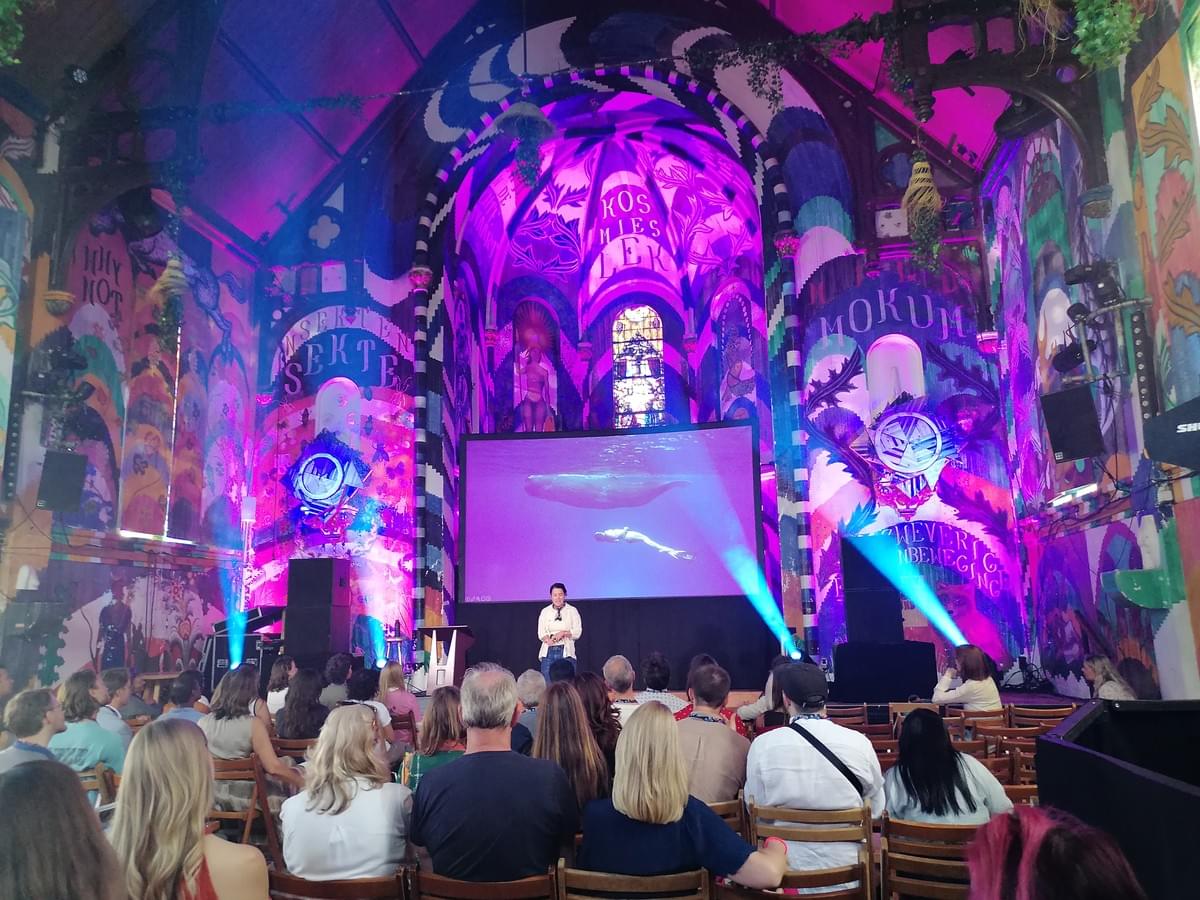
When I started this logbook, I imagined I'd walk you through every key moment of the two days. But I'm realising the limits of that exercise. Every hour was marked by a meeting, a conversation, a discovery that could deserve its own spotlight. But that's not the point here. You have the stage and some of the cast. Now, what was the play about, and what do I take away from it?
The Katapult Future Fest brings together each year an international community of investors, entrepreneurs, activists and thinkers who believe that the systemic crises we face require equally systemic responses. Neither an expert conference nor an institutional summit - something more hybrid, more alive, more daring. This 2026 edition was organised around four threads: the tension between deep tech and humanity, the power of culture and creativity as levers of transformation, regenerative finance and new economic infrastructure, and the relationship between ocean, nature and living territories. Four entry points, one underlying question: how do we redirect flows - of money, attention, energy, power - toward what repairs rather than what destroys?
Beyond the richness of the encounters, discussions and experiences of those few days, I leave with four deeper reflections I'd like to explore over the weeks and months ahead.
1/ The trap of the unifying narrative
During a workshop on the concept of narrative and storytelling (the Epic Narrative session), Nolita - a South African working for an international organisation - is invited to speak. She takes the mic, looks at the organiser, and gently warns him not to hold it against her: "I hope you won't regret inviting me. I'll try not to be too rude."
Nolita then explains she won't be reading the text she prepared. That something rang false during this workshop, and she needs to share what came to her in the last few minutes.
"I feel like I'm in the middle of the Empire."
Once again, white people in positions of power are proposing solutions to those who have none. Not out of bad faith - but we're reproducing the colonial pattern. We bring our solutions (here, a unifying narrative around regeneration), shaped by our own worldviews, our biases, our own aspirations.
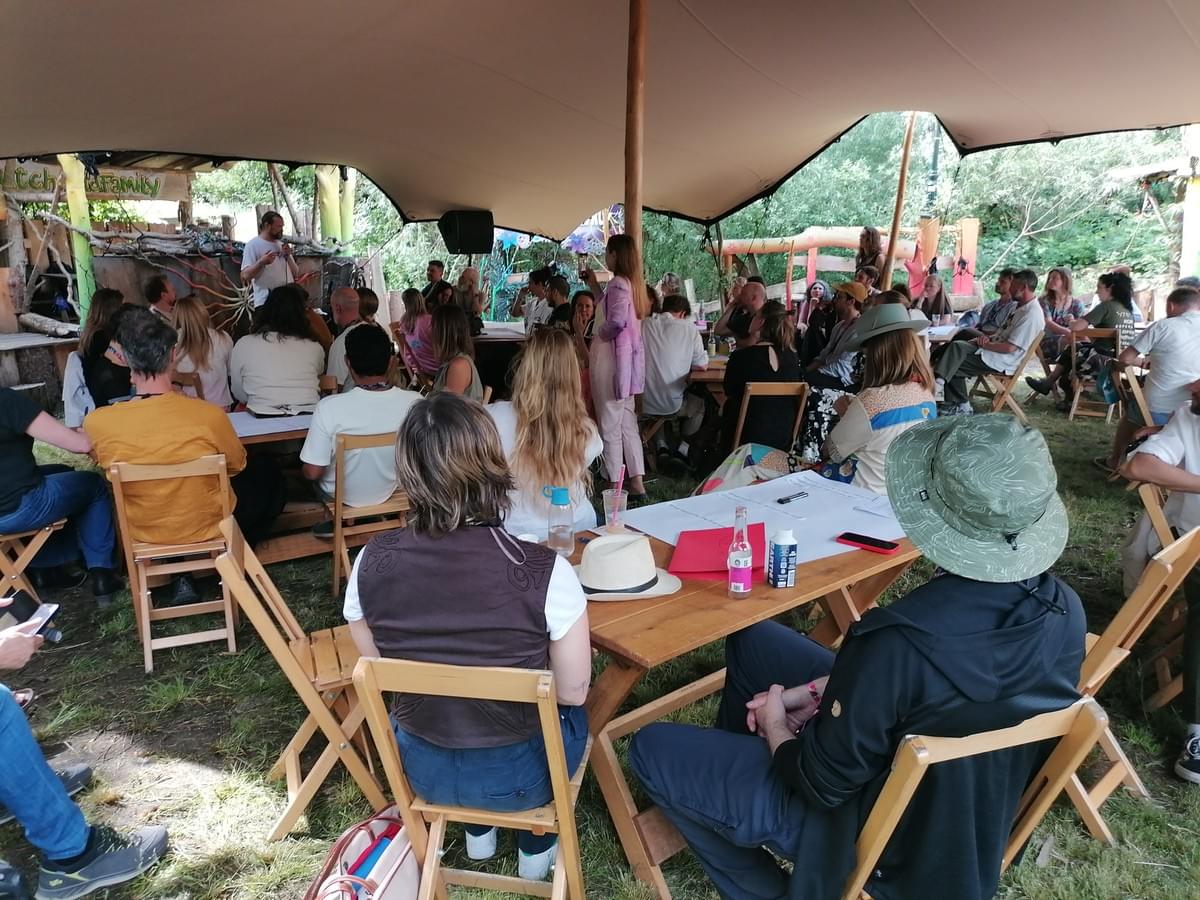
So what do we do? Bringing people together around a shared vision and the protection of living systems still seems like the right direction. Where's the problem? It likely lies as much in the process as in the outcome. Part of the answer came from another person among the minorities in the space.
"We should not seek one narrative to federate the whole world. We'd be creating yet another dominant narrative. We should design and share the tools needed for place-based narratives to emerge - used and driven by local populations themselves - reflecting our diversity."
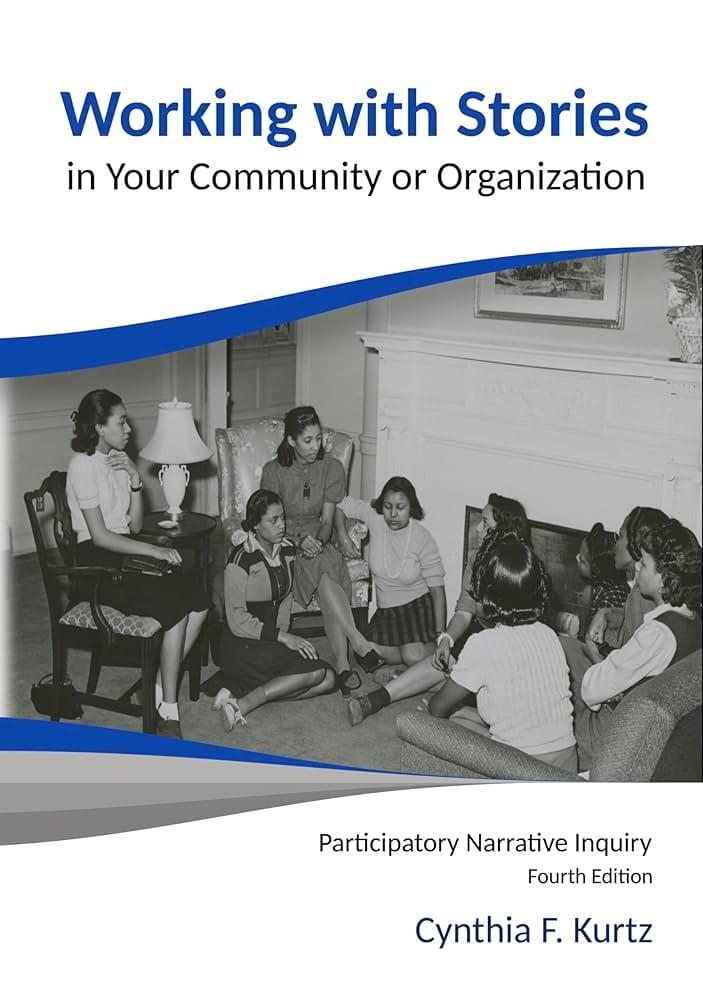
Discussing the topic again later that day, someone pointed me toward PNI - Participatory Narrative Inquiry - a set of methods that start from individual stories to build a shared interpretation of reality. My understanding: PNI tools work at both the individual level (prompting each person to reflect on their own experience, interpret it in different ways, and potentially shift their stance) and the collective level (bringing individual experiences, perspectives and interpretations into dialogue through group workshops). Together, they allow tensions of interpretation to be mapped, the plurality of viewpoints to be legitimised, and a move from "I" to "we" without erasing that diversity of perspectives. Definitely methods worth adding to our toolkit here in our projects.
2/ Society reinvents itself at the crossroads
Several times over these two days, the concept of dialogics comes to my mind. The idea that two contradictory logics (two voices, two forces, etc.) can coexist within the same situation, without the contradiction being resolved, and without one polarity winning over the other. There is no compromise to find, no synthesis to forge, but a tension to inhabit. Where dialectics sees a contradiction that demands resolution, dialogics sees a tension that generates meaning, movement, life - precisely because it is never resolved.
I had the sense that many such tensions were being expressed and collectively inhabited over these two days. Through explicit reactions, yes - but also through silences, discomforts, glances, and bodies that express what words won't allow.
One tension struck me in particular: the tension between power asymmetry and redistribution. As I understand it, the festival's core intention is to redistribute the social power granted by capital concentration - to put it in service of people and of living systems. I found people genuinely open, curious, and attentive. But if we're honest, power asymmetry doesn't disappear, and it reads very clearly in bodies.
In the off moments, you can see how conversations shift in rhythm and depth when certain people arrive. A major fortune, a member of the royal family, an emblematic speaker - and something imperceptibly reconfigures. I don't exempt myself from these dynamics, of course. Redistribution doesn't begin when the asymmetry disappears. It begins when we accept to see it and name it.
The list of such tensions is long - new tech vs. ancestral principles; extractivism vs. regeneration; unity vs. diversity; urgency vs. slowness - and each one would deserve its own exploration. But to come back to the key point: I sensed a genuine intention in the space to welcome - and even encourage - the expression of these tensions. As if there were a shared understanding that our collective creativity depended on them. In practice, I think this rare quality was shaped by three things: the intention set by the organising team (notably Tharald Nustad), the care brought by the Ruigoord community (who have tended this space for decades and welcomed last week this other world with open arms), and the design of the spaces and sessions themselves (built to foster plurality - of perspectives, expression, rhythms, and interactions).
The presence of artists and the space given to the arts was not incidental to this feeling. It's no surprise that our creativity multiplies when all our senses are engaged and space is made for intellect, emotion, and sensation alike. One moment touched me particularly, at the closing. Musicians from across the world gathered around an indigenous song from Amazonia. A musical reminder of the central importance of what precedes us and what we depend upon.
Of course, the contrast between the diversity on stage and the homogeneity in the audience is striking. One more tension to acknowledge and inhabit.
3/ The silent power of emergence
On Thursday evening, the festival broke into small groups beyond its walls. Or rather, between walls. We were invited to dine in homes across central Amsterdam, in groups of around ten. Once everyone had arrived, our host Liet invited us to sit in a circle and offered this opening: "How about we skip all the intro thing and go deep, right away. Would you be ok with that?" Everyone seemed on board - maybe relieved. Liet opened the circle with a question: "What is emerging for you today?"
Being something of a devotee of the concept of emergence - what arises from a system without having been intended, controlled, or planned by any of its elements - this question sharpened my attention immediately. I listened eagerly to each person's deep and considered response. Then it was my turn. And what is emerging in me these days is precisely this understanding - almost physical - of the power of emergence, and of the conditions under which it manifests.
There is a fine line to walk between the proactive work of designing and creating those conditions, and a complete letting go of the outcome itself. Attention rests entirely on the conditions, which must in turn foster interactions within the group or system at hand. And I see it continuously at Katapult. In that space, in that circle, across those two days. Conversations born between sessions, unplanned. Coalitions forming around a table without an agenda. Ideas surfacing precisely because no one was trying to make them surface. Emergence cannot be summoned - it can only be permitted. It requires a different kind of attention: focused on conditions rather than results, on the quality of presence rather than the efficiency of strategy.
Is this all in the mind, or a shared reality? That's for each person to decide. But here are the principles I use to guide my own practice.
- What is the intention I bring to this interaction, this event, this project? It's the magnet that draws everything else. If my intention is unclear, it attracts drift and half-presence. If I'm clear on the deeper reasons for being here, energies align naturally.
- Am I open to the other person? Every person is a book waiting to be explored. We have the extraordinary fortune of having developed an immensely powerful technology called language, and an exploratory toolkit called questions. Together, they allow us to connect - and to form the connections that may (or may not) become the building blocks of something shared. The what and the how remain a mystery until we observe and name them together.
- Do I feel nourished by the interaction? This is the final signal. If the answer is no, I close the connection - even if that means sitting with the loneliness I mentioned earlier.
These three questions form a virtuous circle. Clear intention draws engaged presence. Openness to the other creates connections. Feeling nourished makes you want to return, continue, deepen. And that is how a relationship becomes a ritual - how it takes root in time, becomes a resource. A relationship, a collective, an organisation, a territory, a network: all follow the same logic. What endures is not what was best planned. It is what was best inhabited.
I leave Amsterdam with a dozen people I'd like to stay in touch with. I see concrete points of connection with each of them - projects that might intersect, questions that answer each other, energies that feel compatible. But I resist the urge to formalise everything, to plan everything, to turn every encounter into an action. I focus my attention on these three principles. And I trust in the silent power of emergence.
4/ On the importance of showing up
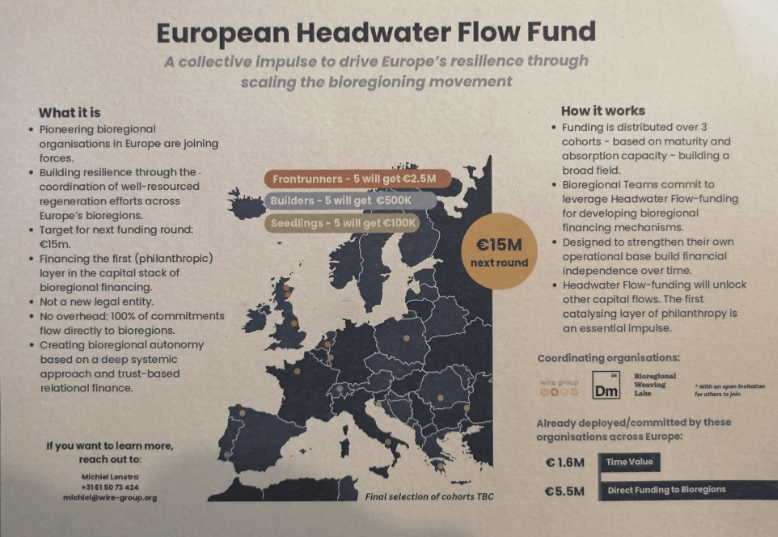
A final word on my presence at this event. Our partners - BWL, Wire Group and Dark Matter Labs - are launching a pan-European fund to finance the emergence, structuring and development of territorial ecosystems working toward the resilience of their bioregion. I was invited by these partners to present our work in the Orne watershed (notably the creation of our placed-based fund), which helped illustrate the real financing needs that exist at territory level.
I noticed that very few ground-level projects were present at Katapult. Mostly investors, foundations, and institutional actors. One participant - herself working at a foundation - shared her frustration with me: "I'm tired of talking about what needs to be done. I need to talk about what's being done now." I realised then how fortunate our positioning is in this ecosystem. We are among the rare "on-the-ground" projects (a matter of perspective, of course - a farmer would smile politely at the label), and so we receive a kind of attention that is unusual in these spaces.
We were offered two slots in the programme to present our work: one focused on our project in the Orne watershed (featuring the beautiful maps from Nous sommes Orne); one to present the Headwater Flow Fund. I was struck by the strength of the BWLC network and our partnerships with Wire Group, Dark Matter Labs and Commonland. The number, quality and complementarity of the people we met collectively, and the conversations held in under three days, was remarkable (we had around a dozen people representing the network across the three days). And after nearly two years of partnership, you can feel a fluency emerging - in our collective ability to move quickly in moments like this, while still taking care of the people, the relationships, and our shared mission. Immense gratitude to everyone who made that possible - Noa, Karin and Michiel in particular - and Deborah for her beautiful energy, critical thinking and care 🙏❤️🙏.
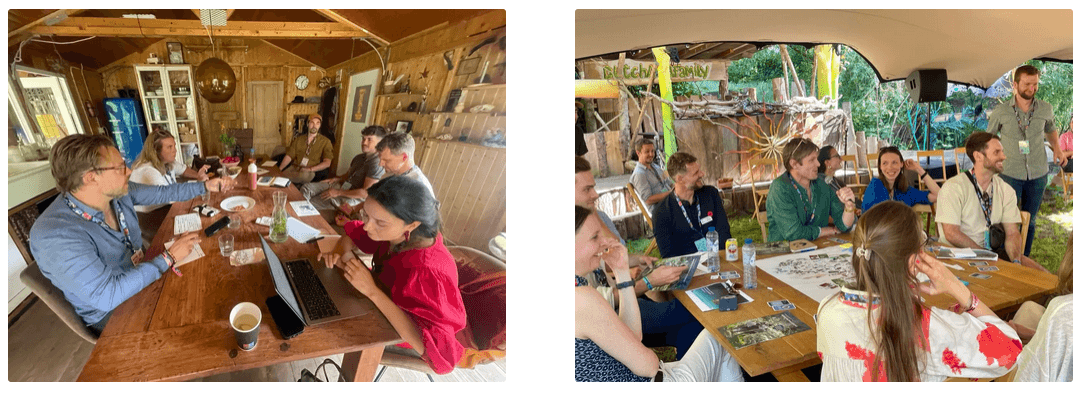
Below, our base of operations during the festival and the participatory session we ran - a role-playing game (conceived by our DML colleague Leon Seefeld) in which participants take on around ten different roles (local authority, investor, resident, insurer, etc.) and must reach agreement on capital allocation decisions in service of the territory.
My feeling at the close of the festival. An image came to me on the final day - not very poetic, but it captures my impression well enough. A group of well-intentioned, competent people asking the right questions - but standing with their hands on a set of taps connected to no pipes. They want to open the valves, but the plumbing doesn't exist. The projects are there. The needs are there. The energy in the territories is there. But the social and financial infrastructure connecting the two is largely absent.
This is the precise gap we have been working on for over a year. This short experience had a double effect on me: it reinforced my conviction that this infrastructure work is essential - and it reinforced a warning about the importance of letting it emerge from the ground up. The build will be slower. But it will be more just, better owned, and more resilient.
The catapult draws its power from the ground. That is where everything begins.