
These journals trace the major milestones of the projects led by the Coop. We share our successes, our slip-ups, our questions, and today, a shift in perspective. This journal looks back at the European Learning Summit 2026, organized by Commonland and the Bioregional Weaving Labs Collective in late April. It covers both the content and the design of the event, serving as a beautiful example of what can be achieved. We’ll be back later to introduce you to some of the inspiring people who were there (they’ll get their own dedicated journal in the coming weeks). Happy reading! 😊
Hello, hello! Jeanne here. Last time, I told you about my 80-hour round-trip bus journey to Romania. I told you that the adventure was well worth the detour because the summit in question—the European Learning Summit 2026—was incredibly rich.
So, it is time to tell you a bit more about it.
To give you a quick recap and some context: this past April, the Oltenia de sub Munte bioregion in Romania hosted the European Learning Summit 2026. Co-organized by Commonland and the Bioregional Weaving Labs Collective, this European summit brought together over 80 practitioners, facilitators, and changemakers from more than 10 countries in Europe. The underlying ambition of this gathering wasn't to brag about the extraordinary work everyone there was doing (although we have no doubt about that!), but rather to come together to:
- Celebrate the work accomplished over the past few years,
- Acknowledge its complexity and the paradox we find ourselves in: a desire to contribute to a different world while the very foundation of our society is still extractivist.
- “We find ourselves in a paradox. We are building the new, while standing on the old” ⇒ an invitation to be mindful of this ambivalence.
- Meet, connect, and build relationships,
- Take the time to reflect on what we have each learned in our own territories and as part of our collectives (both at the local level and within our respective networks, Commonland and BWLC) and to share those insights,
- Look to the future with more tools, stronger connections, and renewed inspiration.
The purpose of this feedback report is to share more with you about the 3 key elements of this gathering:
- The substance of the event (the richness of the program and the themes addressed)
- The form (the pedagogical engineering and the toolbox)
- The people who took part in it
Happy reading!

80 practitioners, facilitators, and collaborators from over 10 European countries
- Photo credit : Miles Rouse & Commonland
Part 1: The substance
🎯 The central objective
For me, looking at the big picture, this event came down to reflecting on a theme that is very close to my heart: cooperation.
Everyone in attendance works at their own local scale to foster and support cooperative bioregional dynamics. The ultimate goal of all this is to define a common purpose with a region's stakeholders, to co-create an inspiring and engaging vision for it, and to move forward together locally in a coordinated way on various projects.
📅 The Program
To foster exchanges that were as rich as possible, the teams from Commonland and the BWL collective put together a 4-day program entirely dedicated to mutual learning and collective enrichment.
- Days 1 & 2: Welcome and getting to know each other
- Arrival on-site, settling in, and initial conversations to get to know one another.
- Presentation of everyone's respective territories and ongoing projects, clarifying "who is who, and who is where."
- Diving straight into the heart of the matter with the first themes and workshops, whose topics were proposed to the participants by the Commonland and BWL teams.
- Day 3: Connection with nature and inspiration
- Moments of collective "meta" reflection, enriched by a common intention for our respective regions, which we celebrated on the occasion of Earth Day.
- Time to disconnect from screens and connect with our environment, including a walk around the Oltenia de Sub Munte region in Romania.
- Day 4: From inspiration to action
- Breakout sessions with topics proposed by the participants themselves in a "workshop" format, co-development sessions, and hands-on workshops using formats prepared ahead of time (detailed below).
- Collaborative reflection on how to move forward together.
An absolute blast.

💡 Themes addressed
When it comes to the discussion topics, our themes were particularly dense and were divided into two main categories in order to blend theory with the participants' concrete needs:
1. Global and conceptual themes proposed by the Commonland and BWLC teams, based on their work with the different territories
These themes covered subjects that affect and resonate with the majority of participants:
- Governance and collaborative work tools
- Funding tools adapted to bioregional challenges
- Facilitating collaboration
- Co-designing strategy and prospective mapping
- The relational pillars of cooperation, such as trust and leadership
- And many more!

World cafe - Photo credit : Miles Rouse & Commonland
2. Practical and co-creation themes brought forward by the participants
These workshops aimed to directly address the concrete questions of those in attendance—whether remaining conceptual or rooted in specific situations from their own territories—including, for example, the following themes:
- Communication: What tactics do organizations use on a daily basis?
- EU Funding: How can we build a joint project idea to apply for European funds together?
- Resilience: How can we translate knowledge and insights to make Europe more resilient?
- Team Cohesion: How do we build a strong team dynamic (team building) dedicated to bioregional development?
- The Future of Cooperation: What are the next steps for inter-bioregional cooperation?
- Finance: How can we ensure that bioregional funding acts as a positive lever for local dynamics rather than putting them at risk?
- And many more!

Topic brought forward by Toos van Noordwijk (Netherland, Wij.land) - Photo credit : Miles Rouse & Commonland
Now, I’m sharing these themes with you, and you’re probably burning to know more: 'She’s talking and talking, but we want to know what actually went down in those workshops!'
I totally get it, and I hope to soon share the insights gathered from all the workshops, which the Commonland and BWLC teams are currently compiling and organizing. Stay tuned!
🧠
And what did I take away from all this?
First of all, I want to say that what I find fascinating every single time is this: you don’t "crack" a subject just by participating in a seminar or a workshop. You discuss it, you enrich (and amaze) yourself with what others share, and you add nuance to your own vision to move toward something more subtle—and perhaps that sounds more right. But in the end, it always comes back to... practice. Cooperation is something you practice, something you live, something you work at. You gather tools to contribute as best as you can to the dynamics at play, but it’s a gut feeling—you feel it, and there is no ready-made, one-size-fits-all key.
- Example 1 — Workshop on Trust & Leadership: The major key concepts related to trust and leadership that emerged from our discussions were: humility, congruence, patience, transparency, integrity, etc. It was incredibly enriching to write them down, to hear the shared examples, and to learn about an indigenous tribe that chooses its leaders through a council of grandmothers. And yet, there were no specific solutions other than increased awareness—an invitation to observe these concepts and try to embody them as accurately as possible in practice.
- Example 2 — Workshop on "How can we ensure that bioregional funding acts as a positive lever for local dynamics rather than putting them at risk?": Here, we first talked a lot about the fact that one of the biggest issues—especially in regenerative agriculture projects—was land access. As the discussion went on, we realized another element was raising questions. Indeed, whenever you say "finance," "a very strong need for governance" always follows closely between the lines. Because bringing money into a territory requires asking the right questions upfront about:
- The purpose, direction, and values we want for a collective
- The governance bodies and decision-making methods that will allow us to choose the actions to move in that direction
- Compensation for the time stakeholders dedicate to the project
- The use of funds
- Concrete example: With the same budget, do we decide to pay external consultants for a study that seems interesting, or do we prioritize compensating the people contributing to the project—both as a sign of recognition for their added value and as a way to support their long-term commitment? (No definitive answer here either; it depends on the project, the expertise needed at a specific moment, etc.)
And there, once again, we didn’t "crack" the subject, but the mere fact of putting it into words, asking questions together, and making things visible means we will all have more elements to consider in our practical realities.
In short, fascinating! But let’s move on to the form...

Workshop “Trust & Leadership”
Part 2: Pedagogical engineering and tools — the form
🎨A wide variety of formats and facilitation tools
As you can imagine, a seminar this dense requires a lot of preparation and organization to ensure a smooth experience for the participants, as these 4 days represent an intense cognitive and emotional load.
The "design team," who organized and facilitated the event, did an amazing job creating a rich and constructive experience for everyone. The success of their work relied on a wide variety of workshop formats and sharing tools, deployed at the right time for the right topics:
- Diversified workshop formats: The event blended traditional workshops with more collaborative approaches such as World Cafe, ProAction Café, and Open Space / Open Forum environments. This made it possible to address themes proposed by both the organizers and the participants, directly responding to their current challenges.
- Varied harvesting and anchoring tools: Throughout the seminar, we practiced "harvesting"—gathering everything that was being said, happening, and shared. This included participants taking notes on A4 sheets or large flipcharts, shared photos, and interviews. A daily journal was also produced, allowing everyone to enrich and digest the moments they experienced.
- Tailored group configurations: Interactions were maximized by alternating between plenary sessions, group discussions of about fifteen people, and more intimate daily "home groups" (the same group of 4 to 6 people throughout the seminar) that were highly conducive to deeper exchanges.


Plenary groups... - Photo credit : Miles Rouse & Commonland
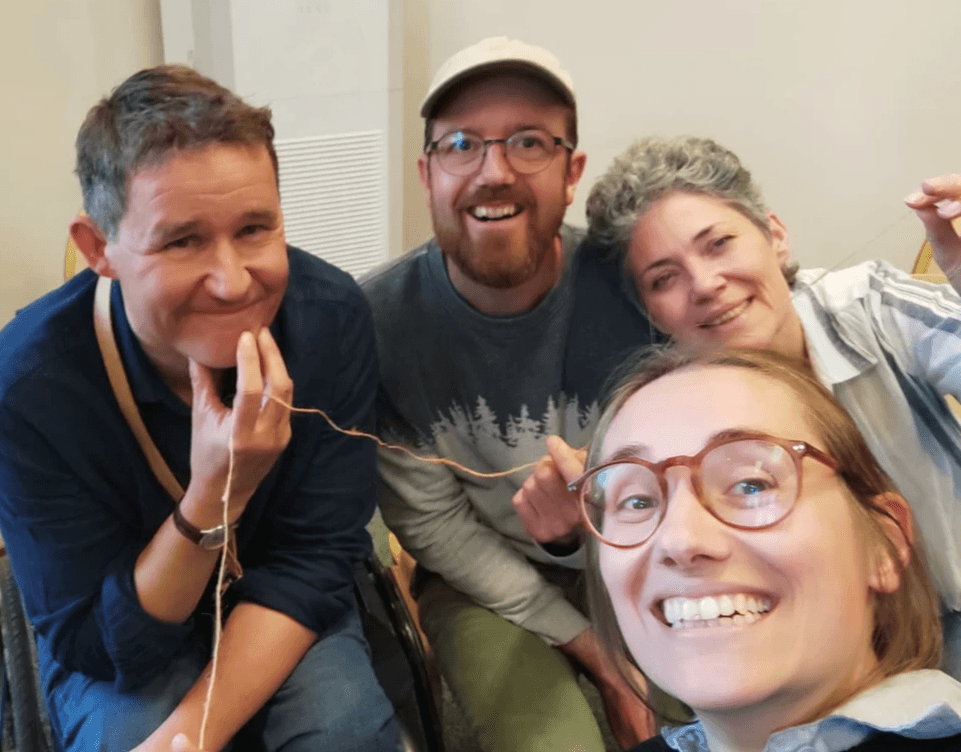
... to my "home group" (shout-out to Harry, Pieter, and Ana) !
- Furthermore, the program safeguarded physical well-being and free time: slots were explicitly reserved for walking in nature, spontaneous informal interactions, and recovery (thanks to a nice sauna!), ensuring that high-quality attention was maintained from the first day to the last, while also leaving room to get some work done if needed.
🇷🇴 Cultural integration: Romania as the common thread
Beyond the technical success of the perfectly organized and facilitated tools, the event benefited from a powerful "thread" thanks to the involvement of the Romanian team, who beautifully integrated the host country throughout the week:
- Immersion in nature and the local community: A field visit allowed participants to experience the Romanian wilderness and connect with local residents.
- Strong symbolism from the very beginning: The event opened with the presentation of a traditional wedding dance, symbolizing the bond being created between stakeholders to grow and nurture one another.
- A lens on society through cinema: The screening of the short film “The Last Time I Harvested the Vineyard,” directed by Gabriela Poiană—a member of the local team from Asociația Kogayon—allowed us to discuss a pressing contemporary issue in Romania. The film explores the depopulation of rural areas and the gradual disappearance of peasant traditions through a deeply personal story, filmed without any fluff—raw, joyful, and moving. ❤️
- An artistic and poetic anchor: Two Romanian artists (Cătălin Rulea and Gabriel Demeter) followed the group incognito throughout the week. Honestly, these guys were incredibly talented: they painted and sketched our shared moments, immortalizing them in a deeply poetic way (see drawings below).
- The art of weaving as a metaphor: Meeting a local weaver offered a beautiful illustration of what cooperation truly means: the art of weaving connections.


The Romanian traditional dance group and the drawings by Cătălin Rulea and Gabriel Demeter - Photo credit : Miles Rouse & Commonland
To sum it up: by combining solid facilitation engineering with a deep cultural connection to Romania, the organizers managed to create an experience that went far beyond a simple technical framework. This approach brought substance, depth, and made the exchanges uniquely rich and successful. So: thank you! 🙂
Part 3: The people
The richness of the event also came, 'quite simply,' from the people who took part in it.
It was an absolute blast to spend the week meeting people with such diverse profiles and backgrounds, all coming together around cooperation and driven by the desire to contribute to a different, more sustainable world.
I’m thinking of Harry Long (UK, West Country Farmers Group), Ana Digon (Spain & Portugal, Asociación de Agricultura Regenerativa), Pieter Ploeg (South Ireland, Commonland), Katharina Serafimova (Switzerland, Lake Constance - Alpstein Corridor), Mark Aink (Netherland, We are regeneration (Decade of Action)), Meg Tarr (South Ireland, Bioregioning South East Ireland), Toni Oliva Suarez (Spain, Pioneers of Our Time), Clare Cooper (UK, Scotland, Bioregioning Tayside), Juandel Río (Spain, Commonland), Carmen Bueno (Spain, Serranías Vivas), Afonso Fontoura (Spain, Commonland), Vishwa Patel (Italy, Future Food Institute), Frank Gorter (Netherland, Akademie van de Veluwe), Manuela Pires-da-Fonseca (Portugal, Cova da Beira Converge), Merijn Dols (Netherland, Biorgional Weaving Labs), Karin Müller (Netherland, Biorgional Weaving Labs), Leon Seefeld (Germany, Dark matter labs), Noa (Netherland, Biorgional Weaving Labs), Andrzej Grupa (Poland, Ashoka Poland & BWL Mid Vistula River Valley), Hadewych de Groot van Embden (Netherland, Wire Group), Andrzej Halasiewicz (Poland, Wielkopolska Gościnna), Nathasha Hulst (Netherland, Biorgional Weaving Labs), and so many others.
Such inspiring backgrounds... I will be introducing a few of them to you very soon... Stay tuned!

Group discussion

Field visit to the Horse Nest while the other groups were in the national park or visiting local monasteries and silk workshops

A friendly moment with Merijn Dols (Netherland,
Biorgional Weaving Labs), Simina Sîrbu (Romania, Kogayon Association), myself, and Natasha Hulst (Netherland, Biorgional Weaving Labs)
📷 Photo credits: For some of the beautiful shots above, many thanks to Miles Rouse & Commonland
👤Every time I mentioned someone, I precised their base country and their organization so you could have a more idea about who were present 🙂
Written by : Jeanne Allard
Envie de suivre les prochains carnets? Abonnez-vous à notre newsletter 😄